Autumn colour and the practical details
Seoraksan in Autumn: Timing and Tips
When Seoraksan's colour starts and peaks, how the weather service counts it, plus crowds, clothing, language and the cable car details that matter.
See Seoraksan tours on GetYourGuide ↗Quick answer
Autumn colour at Seoraksan usually starts on the summit in late September and peaks roughly two to three weeks later, so mid to late October is the usual target for the park's main walks. The date shifts each year, and weekends are busy. Go on a weekday if you can, check current colour reports before you commit, and book something you can cancel.
How colour is counted
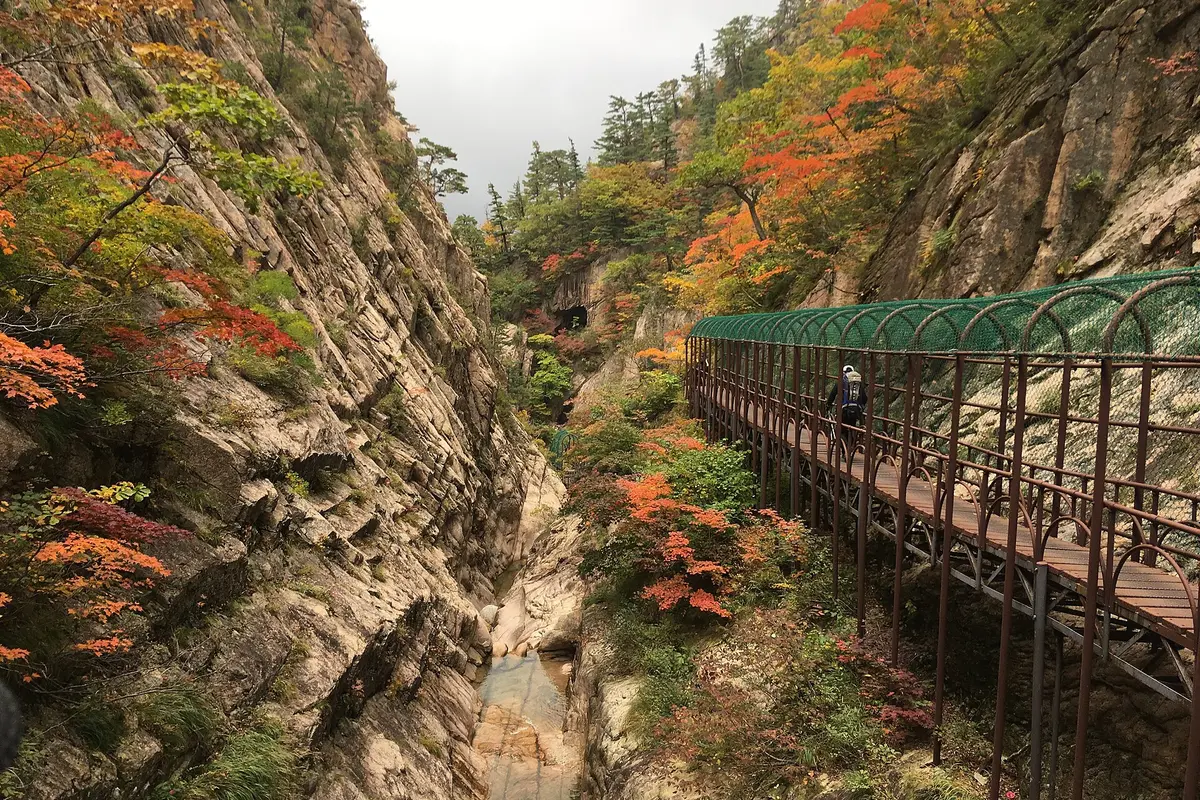
Korea's weather service counts autumn colour from the top of the mountain down. First colour is when about a fifth of the mountain, measured from the summit, has turned. Peak is when about four fifths has. In a table the service published in 2019, Seoraksan's average first-colour date was 27 September, and the average peak date was 18 October, about three weeks later. That is why colour starts in late September on the high ground, while the walks most visitors do come into their best later, around mid to late October.
Planning around a moving date
The exact dates change with each year's weather. In 2019, first colour arrived on 27 September, the same as the average, and the service expected peak about two weeks later. In 2018 the gap was 15 days. So treat any single date as a guess. Current colour reports and the park service's notices are the best guide once you are within a week or two. If colour is the reason for coming, pick a weekday, keep your plans flexible, and book something you can cancel. Free cancellation up to 24 hours before applies when you book the tour through GetYourGuide. A late-season trip has one more catch: the upper-trail fire closures listed by Visit Korea begin on 15 November, so the high routes may be shut.
Weekends, weather and the cable car
The cable car operator says most weekends are busy. Tickets are sold only on the day at the ticket office, with no advance reservation, so arriving early is your main tool. Cars leave every 10 to 15 minutes when it is quiet and about every 5 minutes when it is busy. Strong wind or bad weather can stop them, and the operator refunds unused tickets in full when it does. The operator's site shows a live view of the Gwongeumseong ridge, so you can see the weather at the top before you queue. If you ride up on the last car, you get only about 20 minutes at the top.
What you see at the top
The cable car takes about five minutes each way and ends at the Gwongeumseong ridge, 699 metres above sea level. The ridge carries the ruins of an old fortress. A story told there says two generals, Kwon and Kim, built it in a single night. From the viewpoint you look over the rock ridges toward Ulsanbawi, Sokcho and the East Sea. The ridge also has a small hermitage called Anrakam and an old pine known as Muhaksong. Both stations have a café, and the upper station has a viewing deck and rest area. Time at the top is not limited, but you must ride the last car down.
Walks that suit the season
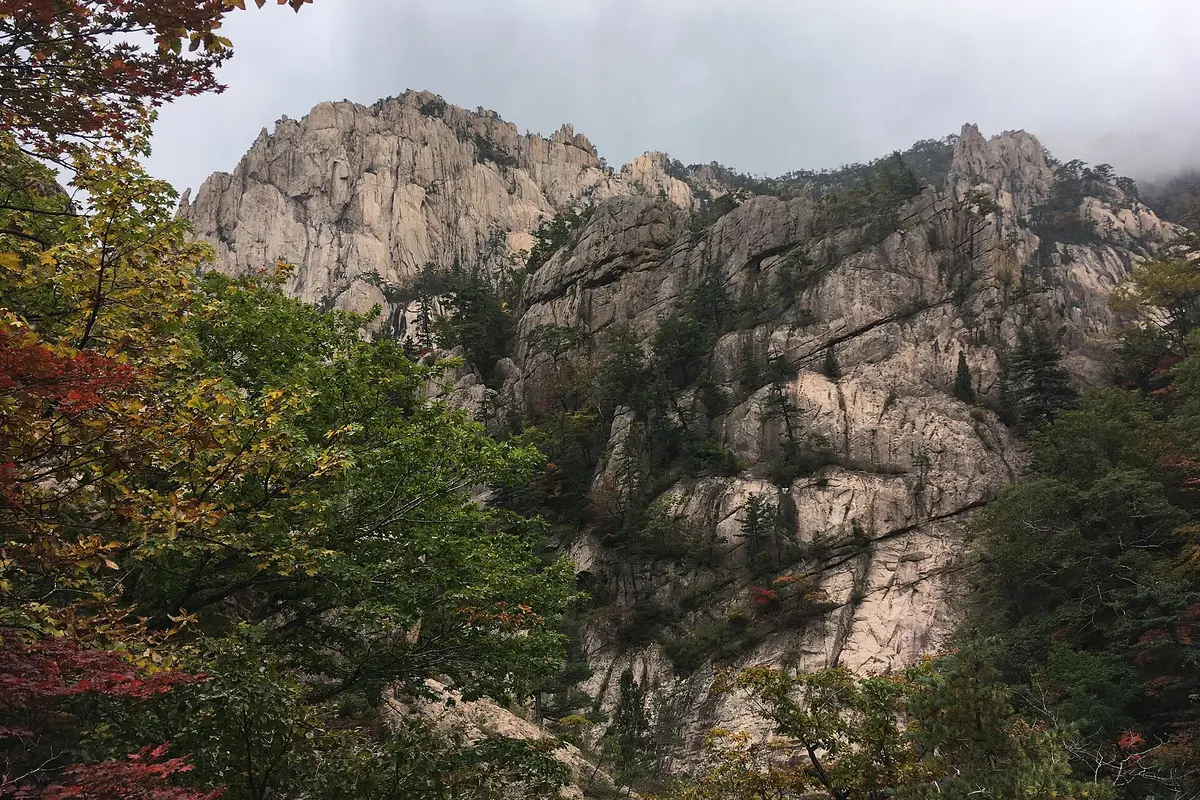
Visit Korea recommends the stream-side trail to Biseondae as the easy hike, and the cable car to Gwongeumseong for visitors with seniors or children. The Ulsanbawi trail is the classic autumn walk: Visit Korea says it is beautiful all year but at its best in the fall. It runs from Sogongwon past Sinheungsa temple and Heundeulbawi, a round rock that wobbles when pushed, to Ulsanbawi itself. The forest path to Heundeulbawi is gentle, and the section beyond is steeper. The full route is listed at 7.6 kilometres and about four hours round trip.
Trail closures and the other seasons
Upper trails in the park close for fire prevention in set periods. Visit Korea lists the closed section as Biseondae Canyon to Daecheongbong Peak, from 2 March to 15 May and from 15 November to 15 December, with the route from Sogongwon to Biseondae Canyon open. Check the park service for the current year. Outside autumn, Visit Korea describes flowers in spring, clear streams in summer and a snow-covered mountain in winter. The winter route of the tour, Option 3, swaps the coast for Nami Island and Eobi Ice Valley, where the frozen waterfall depends on the weather and season.
What to wear and bring
Wear comfortable walking shoes and dress for the weather, as the tour asks. Add a warm layer: the cable car cabins have no heating or cooling, so the air inside matches the air outside. The tour does not include meals or drinks, so bring snacks or plan to buy something at the park. The operator asks visitors to use the toilets in the park before buying a ticket, because the toilets at the top use foam rather than flushing. Smoking is not allowed anywhere in the national park.
- Walking shoes with grip
- A warm layer and a rain layer
- Snacks and water
Language and getting help
The tour guide is listed as English- or Chinese-speaking, so you can ask questions in either language on the day. The cable car operator's website offers Korean, English, Chinese and Japanese. Korea's 1330 travel helpline answers in Korean, English, Japanese and Chinese, which helps if plans change on the day. Save the park stop name, Seoraksan Sogongwon, and the cable car's address, 1085 Seoraksan-ro, Sokcho, on your phone before you go.
Children, strollers and accessibility
Strollers cannot go on the cable car. The operator provides free stroller storage outside the lower station. Wheelchairs can board: a lift takes you to the second-floor platform. There is no walking trail down from the ridge, so everyone who rides up must ride back down. Visit Korea suggests the cable car for visitors with seniors or children. Beyond the station, the easy walk along the stream to Biseondae is the gentlest option, while Ulsanbawi is a steep climb and is not for small children or anyone unsteady on stairs.
Who this isn't for
If you need peak colour on one fixed date, no tour can promise it, because the timing changes every year. If a 12-hour day with long coach rides sounds tiring, a night in Sokcho is a better fit. And if you want a summit hike, a day trip from Seoul does not leave the time: the Daecheongbong route alone is listed at about 10 hours. And if you like to choose your own hours, the public bus gives you that, while the tour follows a group schedule that the booking calendar shows for your date.
Frequently asked questions
When is the best time to see autumn colour at Seoraksan?
Colour usually starts on the summit in late September and peaks roughly two to three weeks later, so mid to late October is the usual target. The date shifts each year, so check current reports and book something you can cancel.
Is Seoraksan crowded in autumn?
Often, especially on weekends. The cable car operator says most weekends are busy, and it sells tickets only on the day. A weekday visit and an early arrival are the simplest ways to shorten waits.
What should I wear on a Seoraksan day trip?
Comfortable walking shoes and clothes for the weather, plus a warm layer. The cable car cabins have no heating or cooling. Tours ask for comfortable walking shoes and weather-appropriate clothing.
Can I take a stroller or wheelchair on the cable car?
Wheelchairs can board using the lift to the second-floor platform. Strollers cannot go on the cable car, and the operator provides free storage outside the station.
Does the tour guide speak English?
Yes. The guide is listed as English- or Chinese-speaking. Korea's 1330 travel helpline also answers in English, Chinese, Japanese and Korean if you need help on the day.
Is the winter route worth booking?
Option 3 swaps the coast for Nami Island and Eobi Ice Valley, where the frozen waterfall depends on weather and season. It suits travellers who want snow-season scenery rather than autumn colour.
Sources
- Directions, fares and FAQ (Seorak Cable Car, operator site, in Korean)
- Seoraksan National Park visitor information (Korea National Park Service, in Korean)
- Autumn foliage observation and definitions (Korea Meteorological Administration, 2019, in Korean)
- Best hiking trails in Korea's national parks (VISITKOREA)
- Trekking through some of Korea's best scenery: Seoraksan (VISITKOREA)
- Seoraksan National Park, inner section (VISITKOREA)
- Seoraksan National Park (Wikipedia)